Introduction
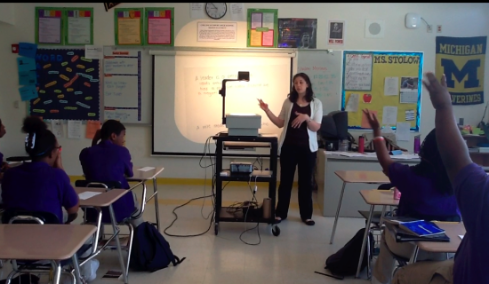 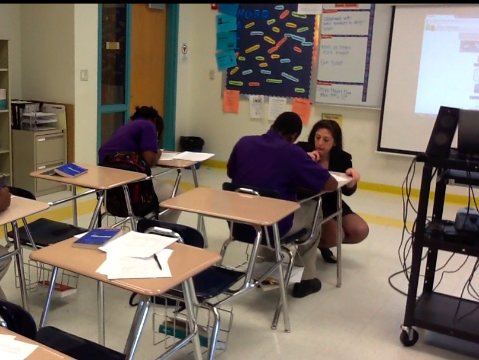 | BackgroundIn 2010, I graduated from the University of Michigan's School of Education with a Bachelor of Arts in Education. Through my student teaching experiences in my undergraduate program I was exposed to rural, suburban, and urban school settings. Each intrigued me in its own way, but I was particularly excited by my experience working in the urban setting. When I moved to Chicago after college, I sought out opportunities that would lead me to teaching urban students. I am currently a 9th grade English teacher at Collins Academy High School in Chicago, IL and candidate for a Master's Degree in Urban Education from National-Louis University. This year, I have participated in the Academy for Urban School Leadership's Urban Teacher Residency program. In this portfolio, you will find information about my teaching experience, student work samples, and analysis and reflection on my profession and important policy.
|

Personal Teaching Philosophy
Today, a classroom teacher does not simply wear many different hats at any single moment, but must have a storage room full of new ones. The classroom teacher must be always ready to pull one out, dust it off and put it to good use.
One of the most important and most urgent jobs of a teacher is to build relationships with her students. I say urgent because it is not something that you can sit around and wait to do. A teacher must constantly and immediately create bonds and bridges between herself and her students. If a student does not feel safe, loved, wanted, valued, or understood by the teacher, they will never absorb any of the content they are expected to learn. I believe that a teacher should get to know not only her students' learning abilities, but their personalities, home lives and family situations, likes and dislikes, groups of friends, and anything else that might impact their performance or interactions in the classroom. This is the only way to truly understand a student when they enter the classroom. A teacher must create an environment in which she shows that she values each student in order to allow them the opportunity to value themselves and each other. In this safe environment, students have the opportunity to try, fail, succeed and learn, but no one is devalued for their effort.
In a constantly changing and moving society, the role of a classroom teacher is not merely to teach the content to which they were hired or assigned. Every teacher must also be giving students understanding, access to and practice in utilizing transferable skills, which they will need to apply outside of the classroom. For example, an English teacher is not just teaching grammar, or essay structure, or even what each character in Lord of the Flies represents. An English teacher is teaching analysis and decoding skills. How does someone make sense of new information in a new context? How do you decipher the differences between two different presidential candidates to inform yourself before voting? Or even, very simply, which toothpaste is better and why? I believe that the role of a formal educator is to go beyond the content and teach other relational, social or professional skills, like arriving and turning in work on time.
Education should open many new doors for each and every student. One of the doors which many schools open for students, as our technological era flourishes, is an enhanced academic experience through technology. Technology in the classroom has completely changed how students experience the content. Having access to the internet allows students to find answers to so many questions which a teacher, a dictionary and an encyclopedia could not provide. It allows students to take a look at a different culture or society, explore a museum exhibit without having to board any buses, or instantly communicate with another student who is thousands of miles away. Technology makes old information exciting and new, by giving students the chance to create games or presentations to share with their class. As our world grows more reliant on machines and technology, having access to such things in school may even spark a student’s interest in a future career path that without the financial capabilities they might never have previously experienced. In our current world, technology and education should always go hand in hand.
I believe that every single child is entitled to a classroom experience in which they have teachers and classmates that love and support them, know them, challenge them, and believe in them. Long gone are the days when a student is just a number and their existence is isolated to a classroom. All students deserve an adult who cares for them, not just in school or in their gradebook, but at all times. If a student does not have a support system at home, it is our responsibility as educators, mentors and coaches to provide that child with a safety net that he or she can rely on.
I do not feel that any of these ideals are a privilege for only students who are wealthy, or those who seem to have a functional home life, or those who live in the “right” neighborhood. All children should be allowed to have the right to a strong public education, and the opportunity to pursue any and all of their goals, hopes and dreams.
