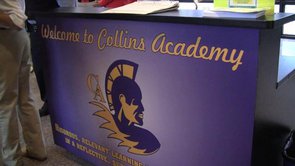
I am teaching this learning segment at Collins Academy High School, an AUSL high school serving 9th through 12th graders, located in the North Lawndale neighborhood on the west side of Chicago. The students at Collins Academy come from the neighborhood of North Lawndale and the surrounding communities. The high school is situated right against Douglas Park and near Mt. Sinai Hospital. The physical proximity of the school to the park and the hospital means that there is always some amount of noise coming into the school from the outside property. Additionally, Collins Academy is housed in the same building as North Lawndale College Prep, a charter high school. The two schools have very limited connection and interaction, and the flow of the building is set up to separate the two groups of students. However, the schools are not on the same schedule every day of the week and there is some additional disruption that comes from having another program running simultaneously in such close proximity. The neighborhood is a low-income neighborhood, with many homes and buildings boarded up, however it is far from abandoned. There are always people walking around and on the hot days one can find groups of people gathering on the corners and stoops in the neighborhood. There are many schools in the surrounding area, ranging from public to charter.
The 9th graders are not necessarily tracked, but there is a group of “honors” students and the other groups are unclassified. The students find great pride in being considered the “honors” class, even though the two groups do not have huge differences in abilities. Within the non-honors class, which is the class that this learning segment was taught in, there are a broad range of abilities and levels (from way below to students who are right at grade level).
In my own practice, I am currently focusing on Danielson’s Domain 2, classroom environment. In mid-February I transitioned from the residency at Chicago Academy High School to being the lead teacher in this classroom at Collins Academy. Through my transition I have been focusing on getting the students to meet all necessary standards for the year as well as improving my own practice in classroom management.
At Collins Academy we work with the ACT College Readiness Standards to focus and guide our planning and teaching. In this semester we have been working on the standard of making generalizations. In this segment specifically we will be working on making and articulating judgments, a writing standard that carries across the four quarters of the school year.
Data Use/Assessment
Due to Collins Academy’s participation in the AUSL network we use the AUSL interim exams to assess our students’ skills and how well they have met the quarterly standards three times a year. For English classes, the students take a reading interim exam as well as an English (grammar) interim exam. The data from the interim exams are used on an individual basis by teachers to make decisions about how to teach or re-teach material. The data was also shared with the students after their mid-year interim exams, to help them formulate goals for the second semester. Additionally, 9th grade students are assessed with the NWEA MAP test. Finally, 9th grade students took the Explore exam, the first pre-test for the ACT in May. This exam broke up some of the days of instruction, which meant that I needed to do a little more review when they returned from the testing.
In my instruction I primarily use Do Now and Exit Ticket data as well as reviewing the work that students do during class time to inform my instruction. I have found that for this group of students homework is not the most effective means of testing understanding, because it rarely comes back to school. I infrequently send home small assignments to be completed and do my best to review these assignments in class the following day or return feedback to the student within a day. At intervals throughout a unit I will give quizzes to assess their understanding.
About the Class Featured in this Assessment
The class featured in this portfolio is a 9th grade Survey of Literature and Reading Class. Survey of Literature and Reading are two mandatory, year-long classes for all Freshmen at Collins Academy. Although Survey of Literature and Reading are technically two separate classes, I have chosen to merge much of the content because it inherently overlaps and I see the same students for both classes.
This class meets every day for 100 minutes. The scheduling of the class is such that the students have their two classes back-to-back; I have them for 50 minutes during 5th period and 50 minutes during 6th period. They leave my class for a 5-minute break during the passing time in between and then return for the second class. Most days my classes are structured as a series of shorter activities, two per class period. My activities are strategically planned to provide opportunities for the students to calm down when they first come in and their energy is too high for a productive class period and to be actively involved, either in partner or group work, at times when their energy is lowest.
The classroom is set up in rows of 4, each row facing a white board in the front. The desks are numbered and color-coded, so that they can easily become groups, if needed. I have a laptop and speakers, LCD projector, and overhead projector, which I frequently use during instruction. All students are situated so that they are able to see the media if needed. Other resources that are available to the students are my classroom library, which includes dictionaries and thesauri, the school’s media center, and the school’s library.
This learning segment comes at the end of a larger unit on Nelson Mandela. The students will have completed reading excerpts from Nelson Mandela’s autobiography Long Walk to Freedom, which is found in our textbook. They will also be using the film Invictus, which we will be viewing as a class.
About the Students in the Class Featured in this Assessment
In my 5th/6th period class there are twenty 9th grade students, between 14 and 15 years of age. The class has a breakdown of 10 male to 10 female students, with no ELL students and 5 students with IEPs. There was particularly low attendance when I was teaching the learning segment, possibly related to the proximity of the end of the school year. Each day I had approximately 11 students (usually the same 11, give or take).The significant absence of students affected the number of voices that there were to be heard in the class discussion, and for those students who missed particular days of instruction, there was significant catching up to do. The absences are noticeable in the film clips.
This particular group of students is very hard to get focused and engaged in work. When the students are given a very short and specific task, they are engaged and able to complete it efficiently. However, these students do not handle self-directed work time well and have a difficult time having academic conversations with their peers. The text that we have been studying has some difficult language and concepts with which they are unfamiliar. Again, the spotty attendance issues clearly impact their understanding. There are students who have missed some or all of the instruction of the initial prewriting. This affected their overall understanding of and ability to create the final product.
I have a few students who need to be pushed in order to reach their full potential and a few students who need more supports than are usually in place. In my planning and design of the lesson sequence I have taken both these groups of students into consideration, and I will be addressing their needs individually and periodically throughout the course of the learning segment.
Other Contexts
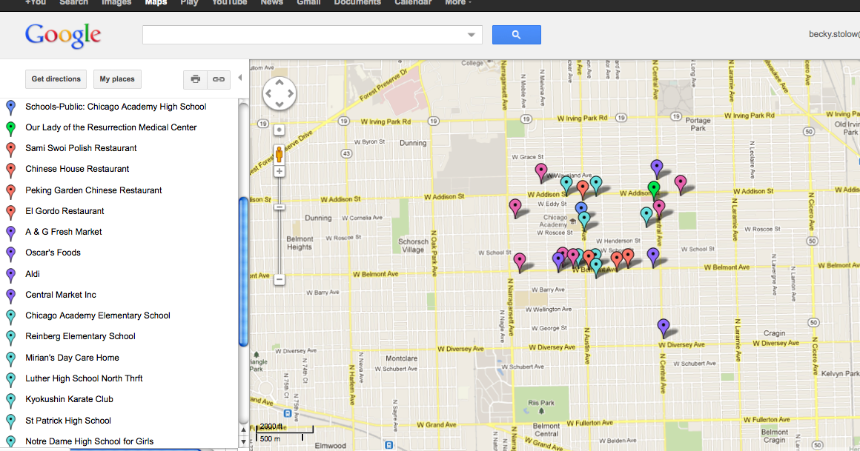
As a resident at Chicago Academy High School, I had the opportunity to observe many different aspects about the community in which I was teaching. These experiences provided context for me to understand my teaching. Below you will find a Voicethread and Community Map for the community surrounding Chicago Academy High School.