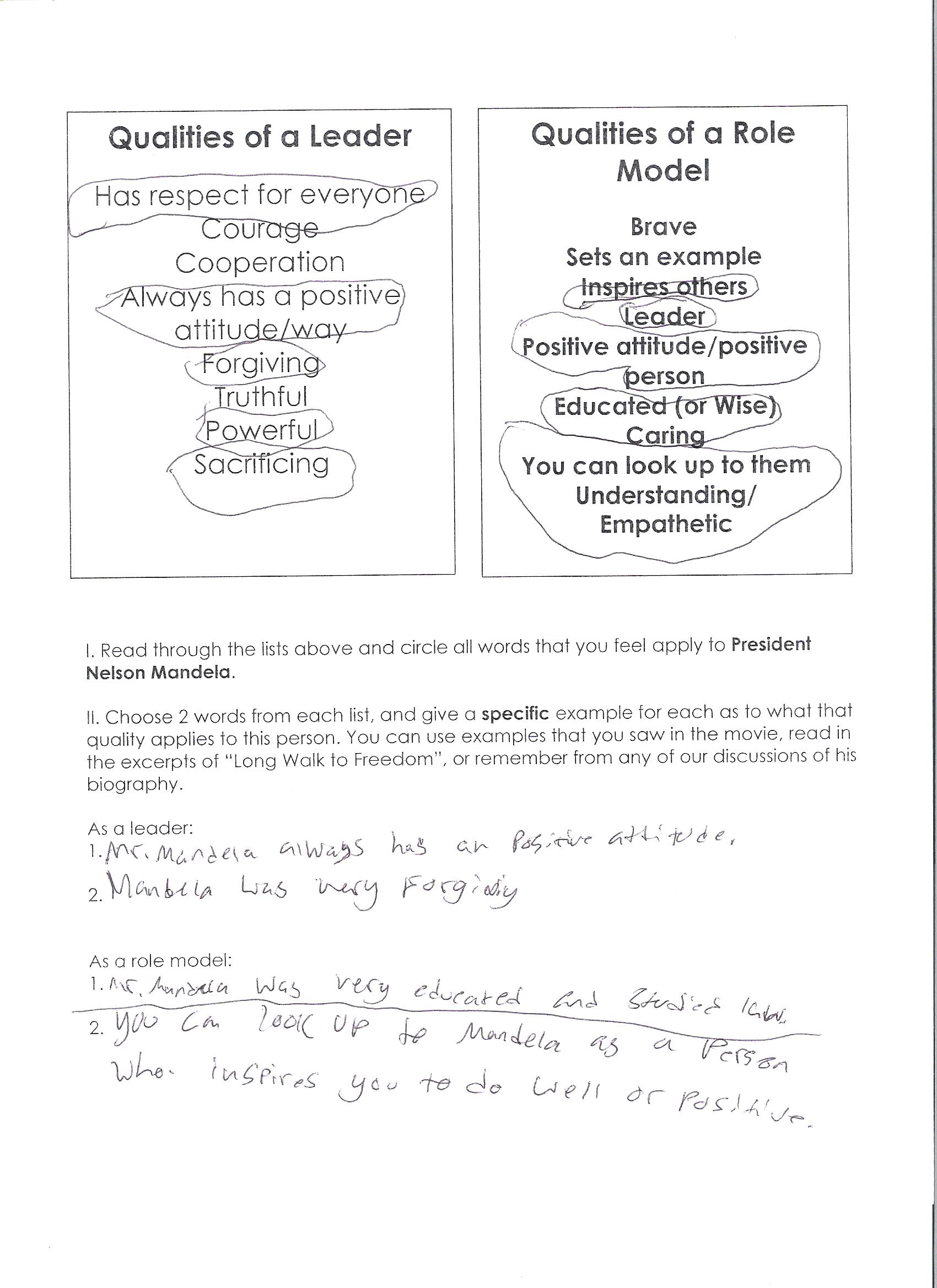
Analyzing Student Learning This assignment aligned with the ACT Reading College Readiness Standard of generalizations and conclusions (draw generalizations and conclusions about people, ideas, and so on in more challenging passages) and ACT Writing College Readiness Standard of expressing judgments (take a position and support it with evidence). The objectives, which I developed for this series of lessons, were: ● Students will be able to identify key qualities of leaders and role models (especially those that can be identified in President Obama and President Mandela). ● Students will be able to develop a well-supported written explanation to a given question through a Three Part Response.
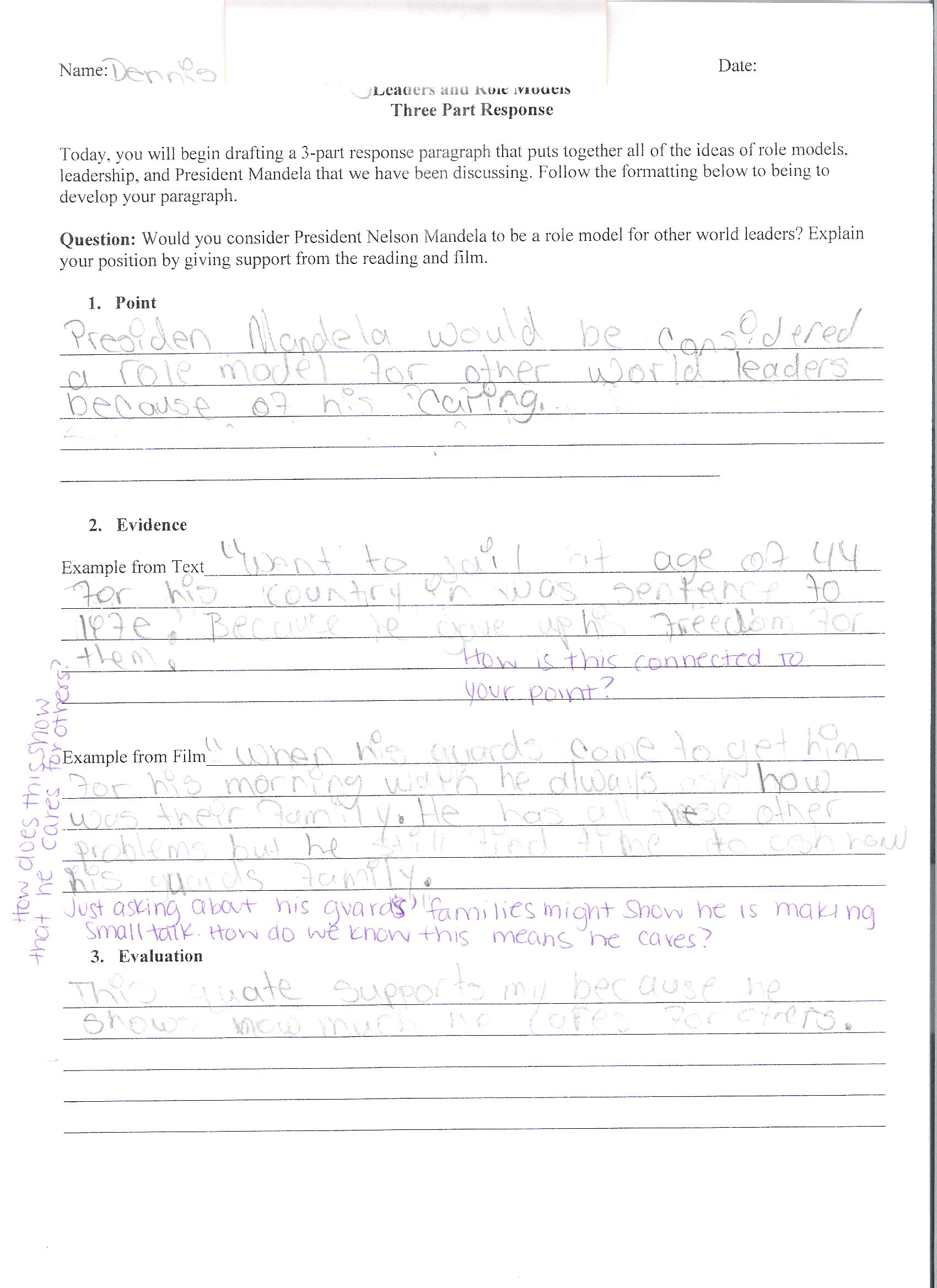
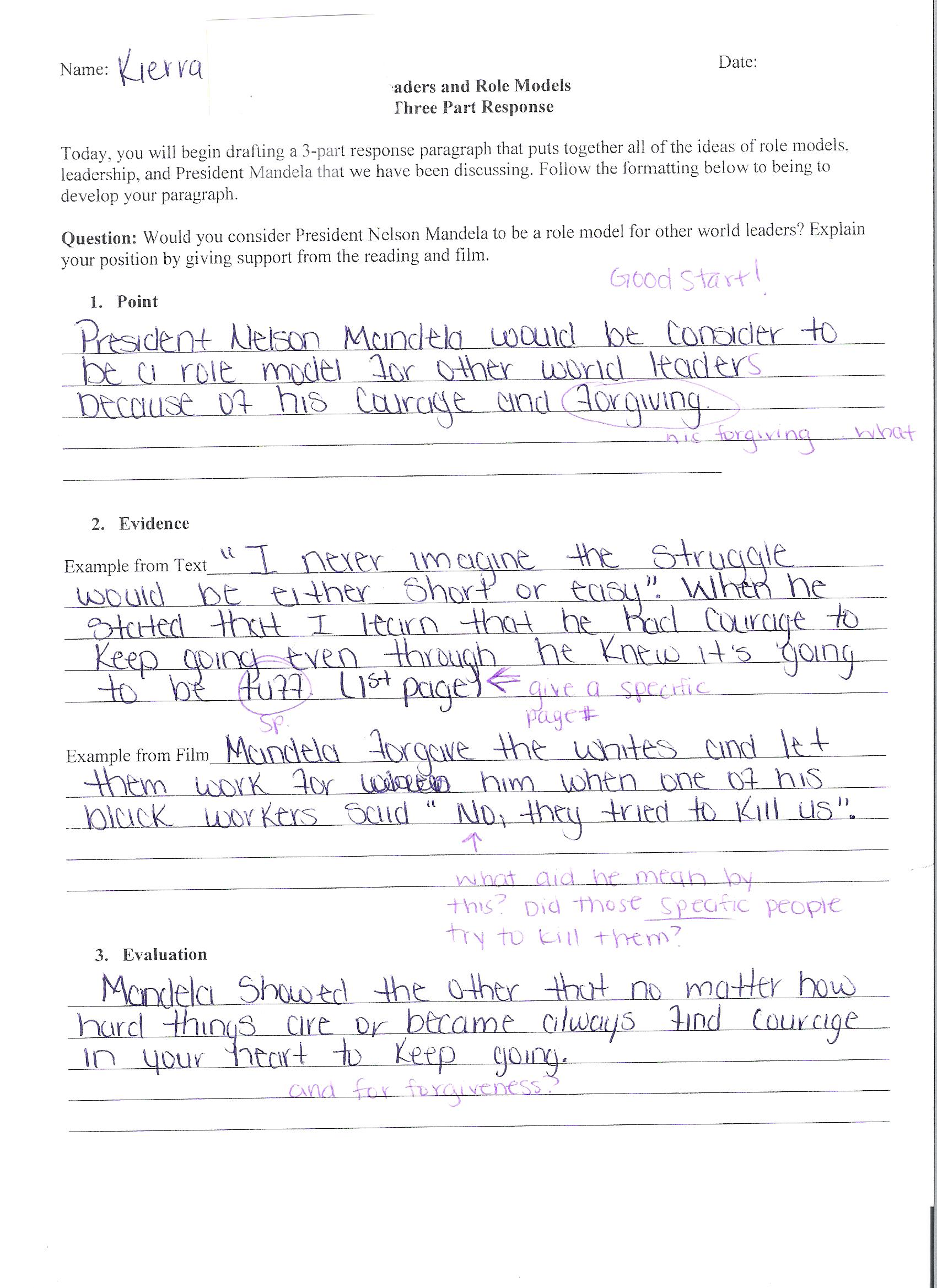
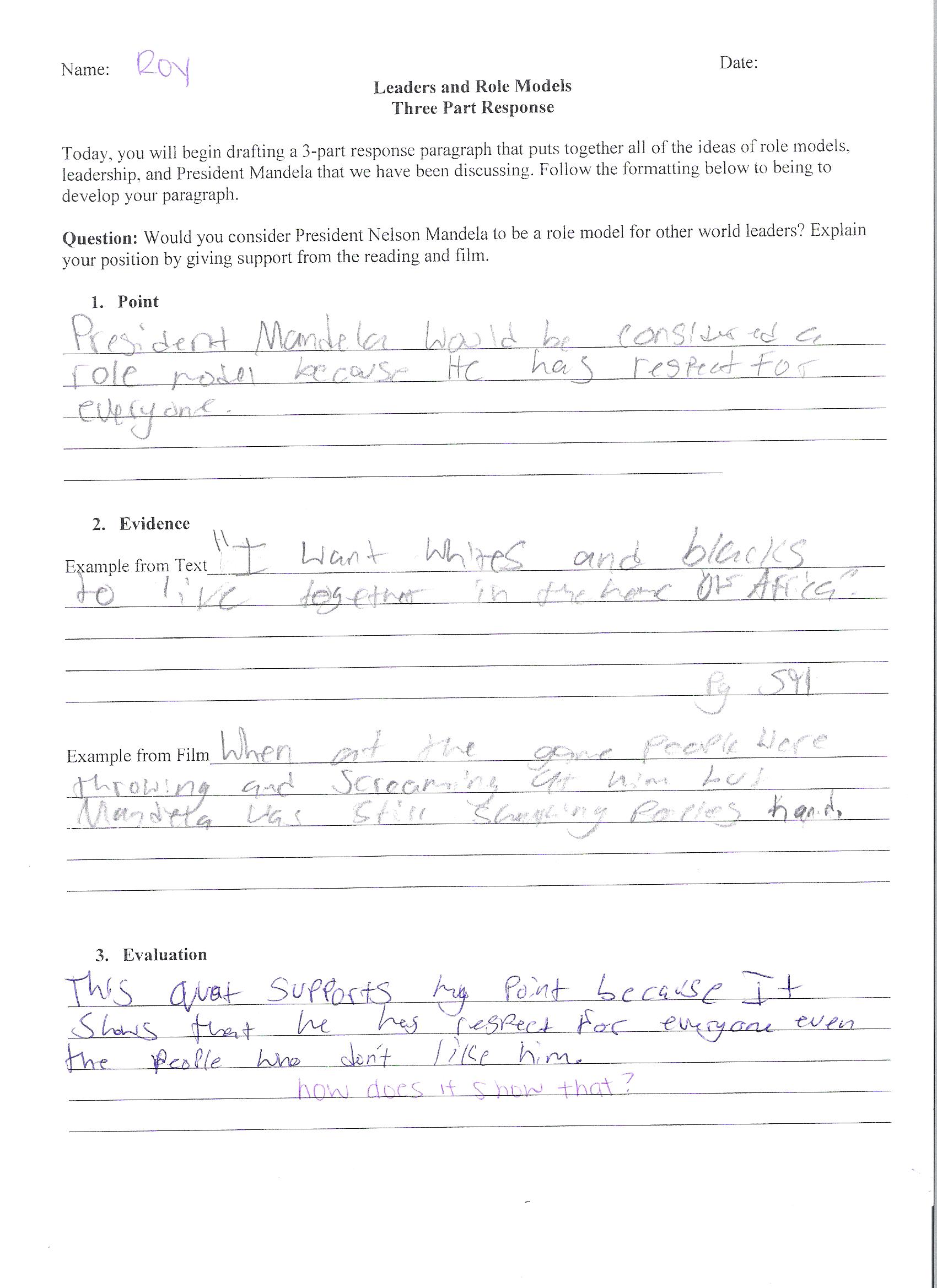
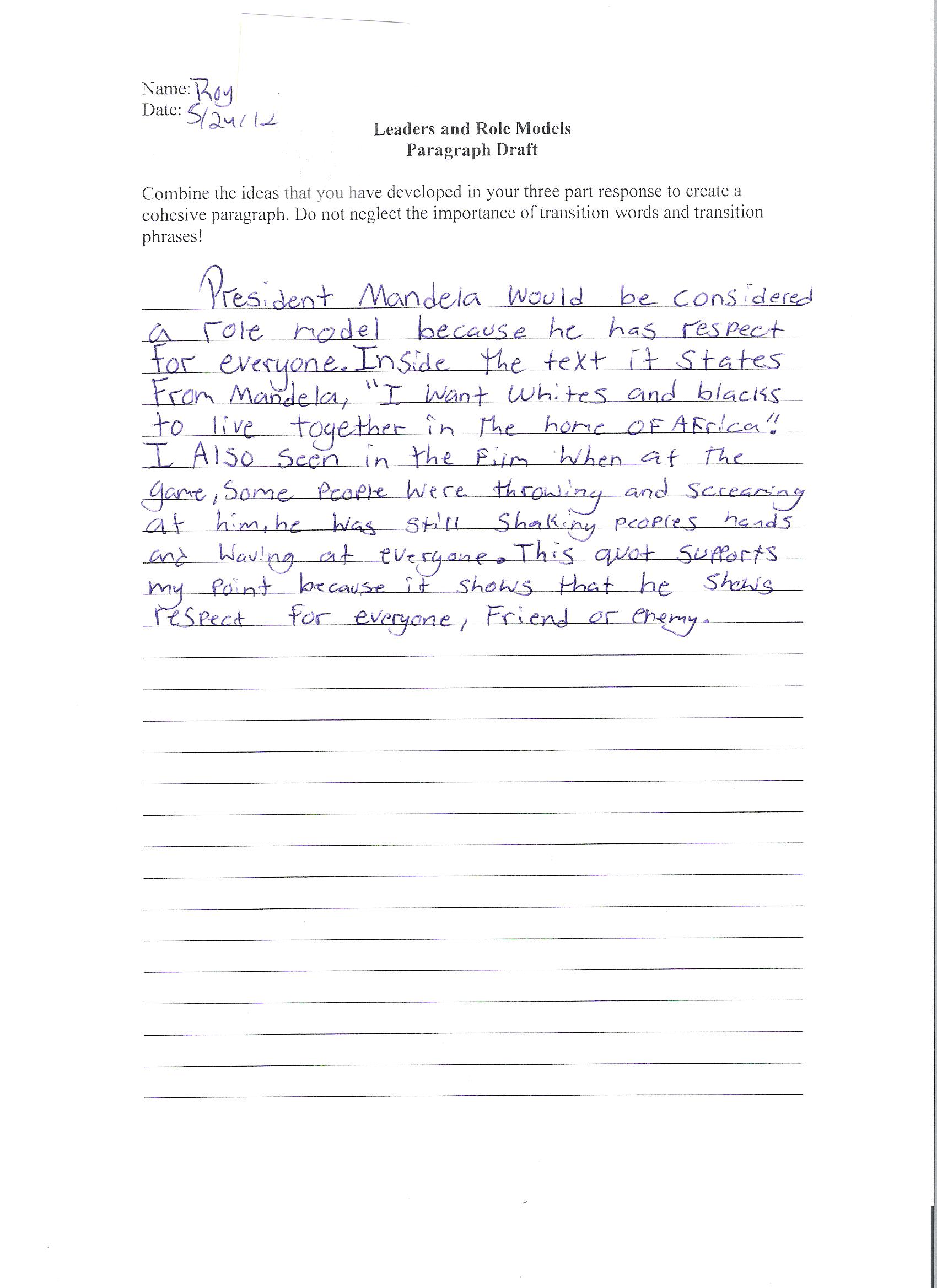
At this point in time, the work that I have collected from the students is not their final draft. Their final draft will be submitted to me in the last week of the school year as their final writing assessment. Through the last two weeks of the school year, we will be working on turning their first drafts into completed and edited paragraphs. For this portion, I will be assessing their most recent draft based on the rubric that I have created for their final assignment. The students were given this rubric before they began their first draft, so that they have a clear understanding of what their goals should be in completing this assignment. Looking through each of the rough drafts, there are two common struggles that I have noticed. First of all, because I modeled portions of the assignment and gave a specific example of how to begin the paragraph there are many students who have copied down the ideas that I developed. This has caused these students to struggle with choosing relevant evidence and accurately evaluating their evidence. I deliberately gave the students a broad opportunity to defend their point; I believe it is more meaningful, authentic, and supported if they draw from their own experience and prior knowledge, and not from something I have given them. The second common difficulty I see is that students continue struggling to develop their evaluation. For example, one student who was defending the argument that President Mandela was a role model because he is caring said in his evaluation, “This quote supports my [point] because he shows how much he cares for others.” This evaluation does describe the purpose of choosing that quote, but it does not sufficiently explain why this example shows that he cares. My feedback to the student is, “How does this show that he cares for others? Just asking about his guards’ families might show he is making small talk. How do we know that this means he cares?” I aimed my feedback to have this student ask himself why this quote is important, not just what it proves. The evaluation portion of this assignment is arguably the most difficult task to understand and to complete. However, it is the portion that brings this assignment from a simple identification task to an analysis/synthesis task. It is important that students push themselves to develop these higher-order thinking skills so that when they are asked to write analyses for larger and more complicated pieces of text they understand the basic model and structure. Woods (2009) argues that, “when students recognize the thinking inherent in writing, they start to recognize their own thinking and then the thinking that invests the world around them with meaning” (p.19). It is just as important that the students understand how to think about these ideas as it is for them to effectively communicate their thoughts. One strength that I see through most of the student work is that students were able to develop an arguable point, utilizing specific language that we developed for defining role models. I also observed that most students were able to identify at least one example from either the text or the film that is strongly connected to their point. The more closely and explicitly connected the evidence is to the point, the more easily I feel the students will be able to evaluate their evidence. One student’s point was “President Nelson Mandela would be consider[ed] to be a role model for other world leader[s] because of his courage and forgiving heart.” The evidence that she chose to support this point was a quote from the text that said “I never [thought] the struggle would be either short or easy,” and she went on to explain “but he didn’t give up.” This student’s evidence shows a strong connection to her point without using any of the key words, such as courage or forgiveness. The courage in this example is implied. This shows me that this student has a clear understanding of the text and the descriptions provided.
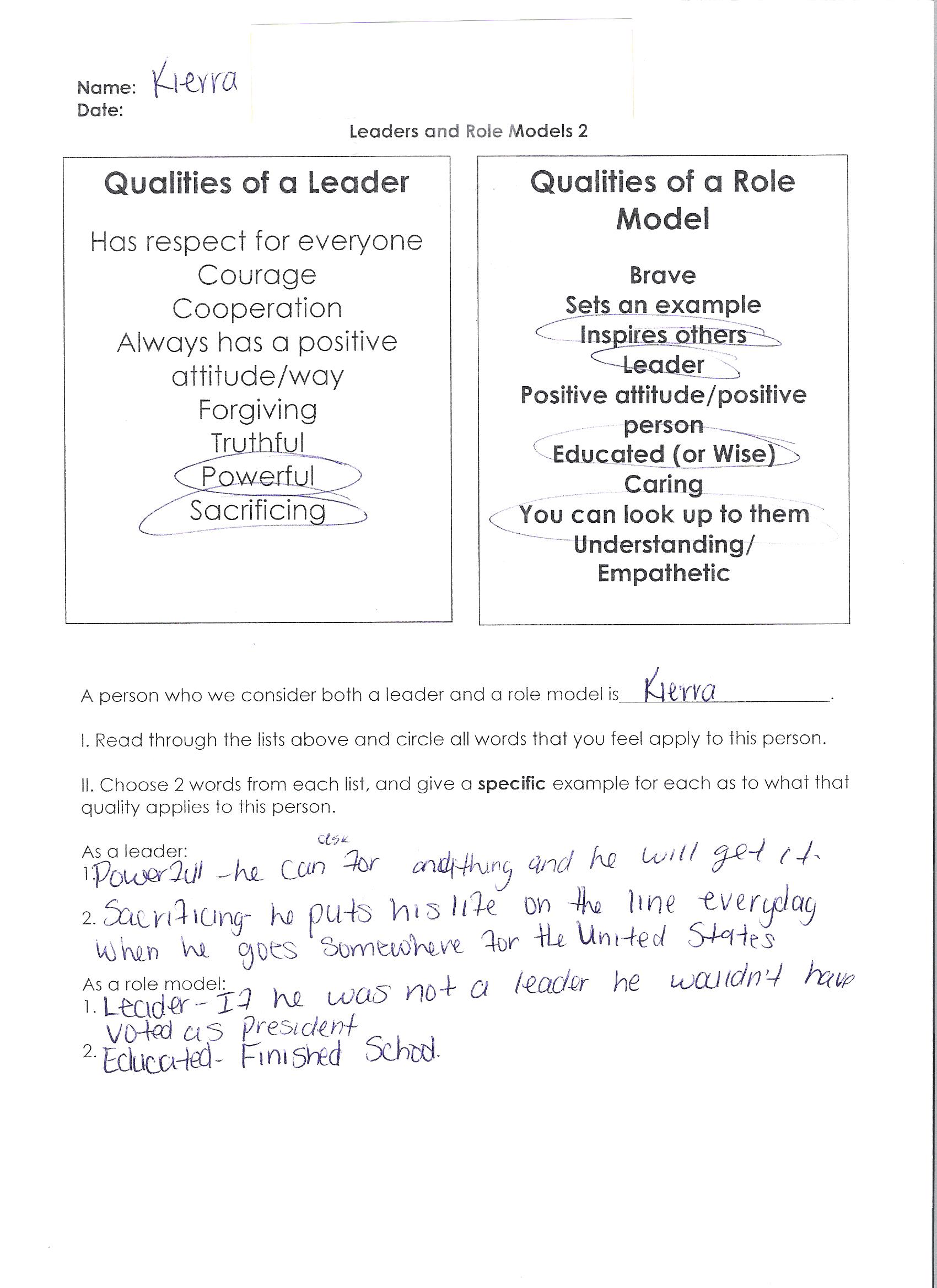
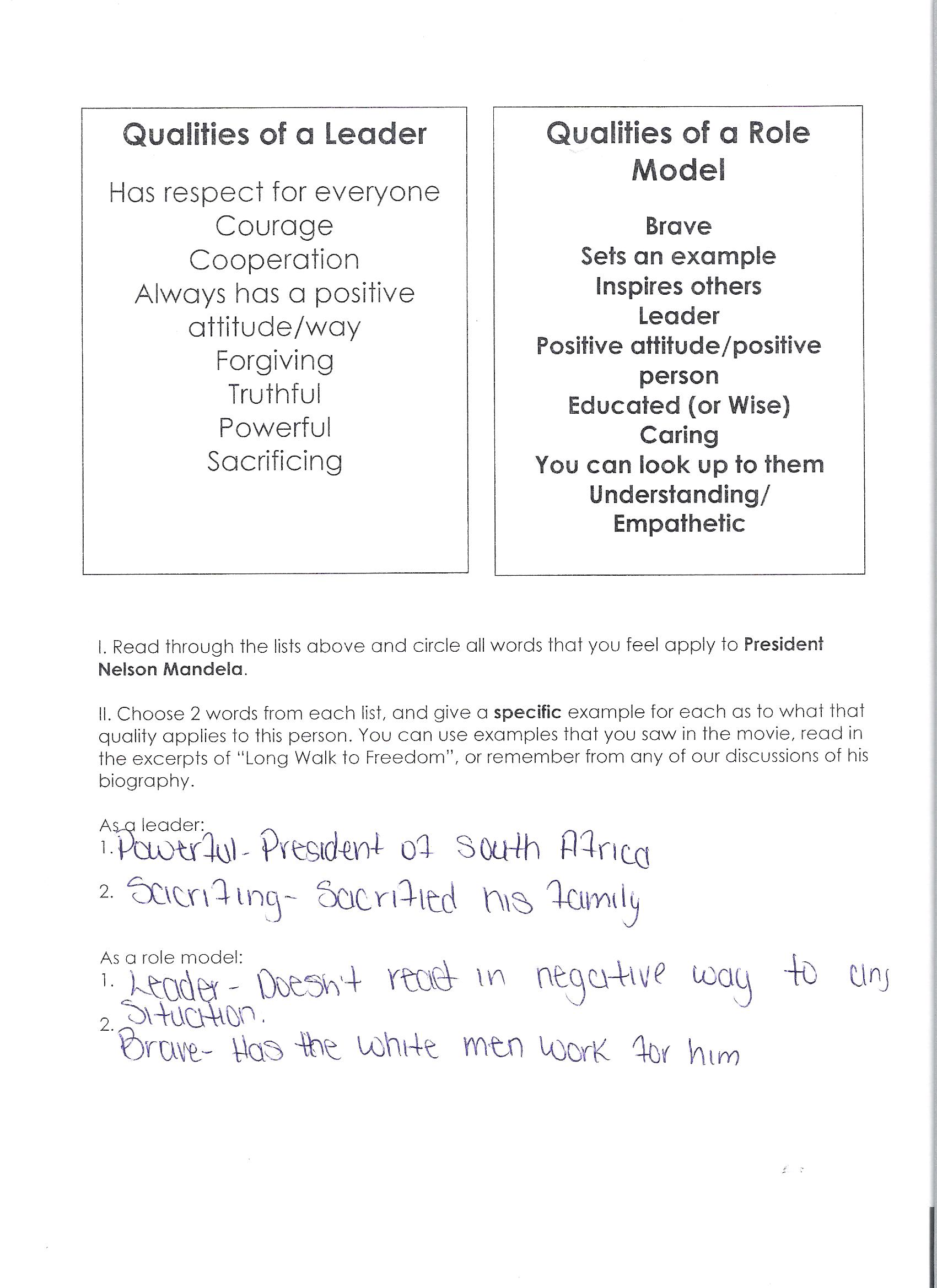
Focus Student Evaluation Student 1: Kierra Kierra is a strong writer, has a fairly well-developed vocabulary, and is one of the few students in the class who is reading right on grade level. Kierra has shown strong abilities in analysis and comprehension. She is usually a very respectful and responsible student, who is most frequently on task and focused during class time, with a good sense of humor. Although Kierra was one of the students absent on the first two days of the lessons, her focus and commitment to her work helped her catch up quickly. Kierra jumped right into this assignment after we had already been through the brainstorming process for the definitions, but her work does not show signs that it is suffering because of that. After being provided with the materials that she missed, she was able to successfully complete her first Three Part Response outline and developed a strong first draft of her paragraph. Kierra demonstrated that she has a strong understanding of how to choose relevant quotations to support her point. In her outline, her point was, “President Nelson Mandela would be consider[ed] to be a role model for other world leaders because of his courage and forgiving.” Both of her chosen examples were clearly and explicitly connected to that idea. Her example from the film was “Mandela forgave the whites and let them work for him when one of his black workers said ‘No, the tried to kill us’.” Although I did question the accuracy or the context of the quotation, there was a linear connection between the example and the point that she was defending. Additionally, Kierra was one of the only students in the class who was able to successfully incorporate transition phrases and sentences, a skill that I emphasized and gave brief instruction in, into her first draft. Kierra is one of the higher-achieving students in the class, and it is evident that she has a strong grasp of this concept through her writing.
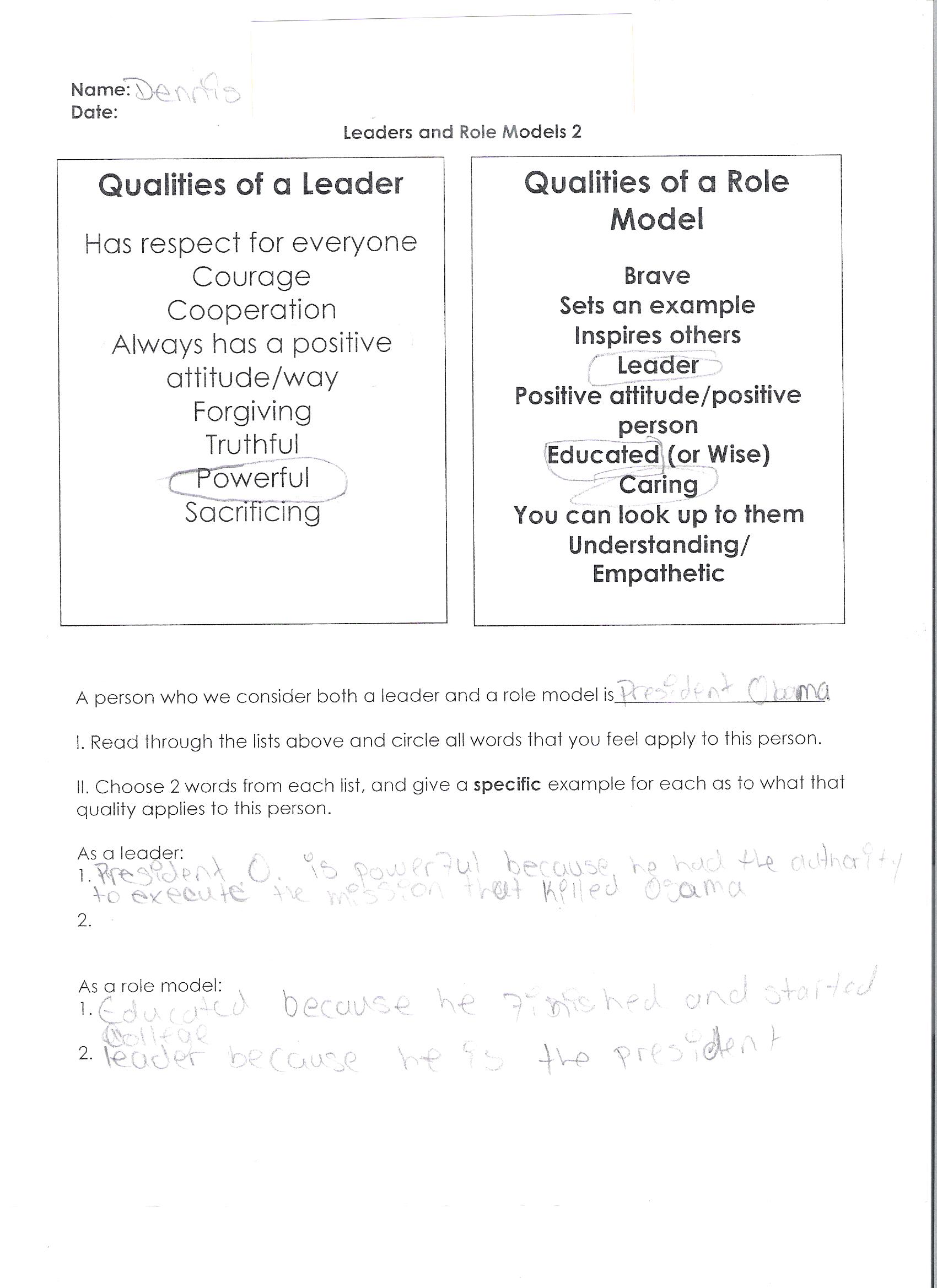
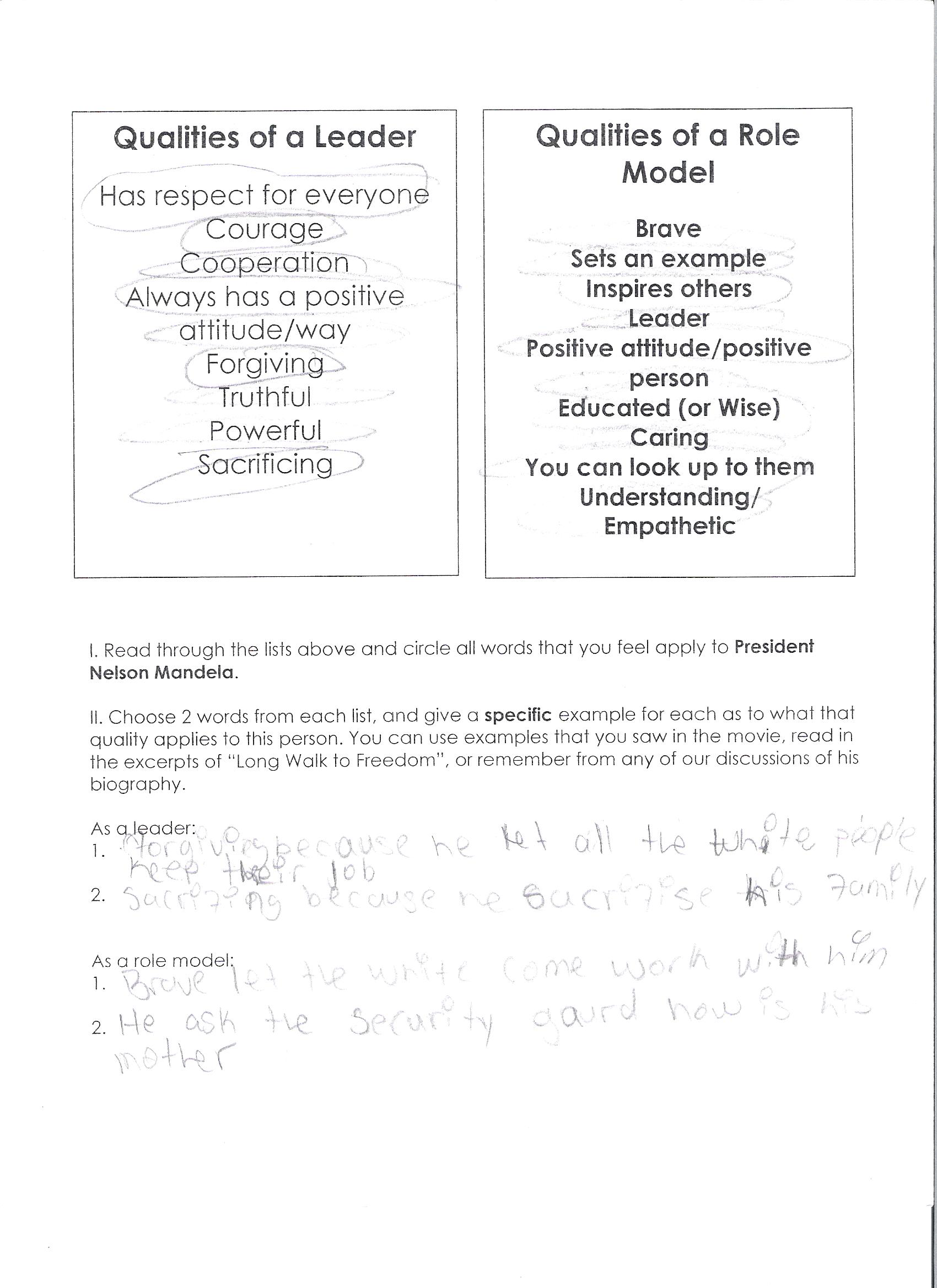
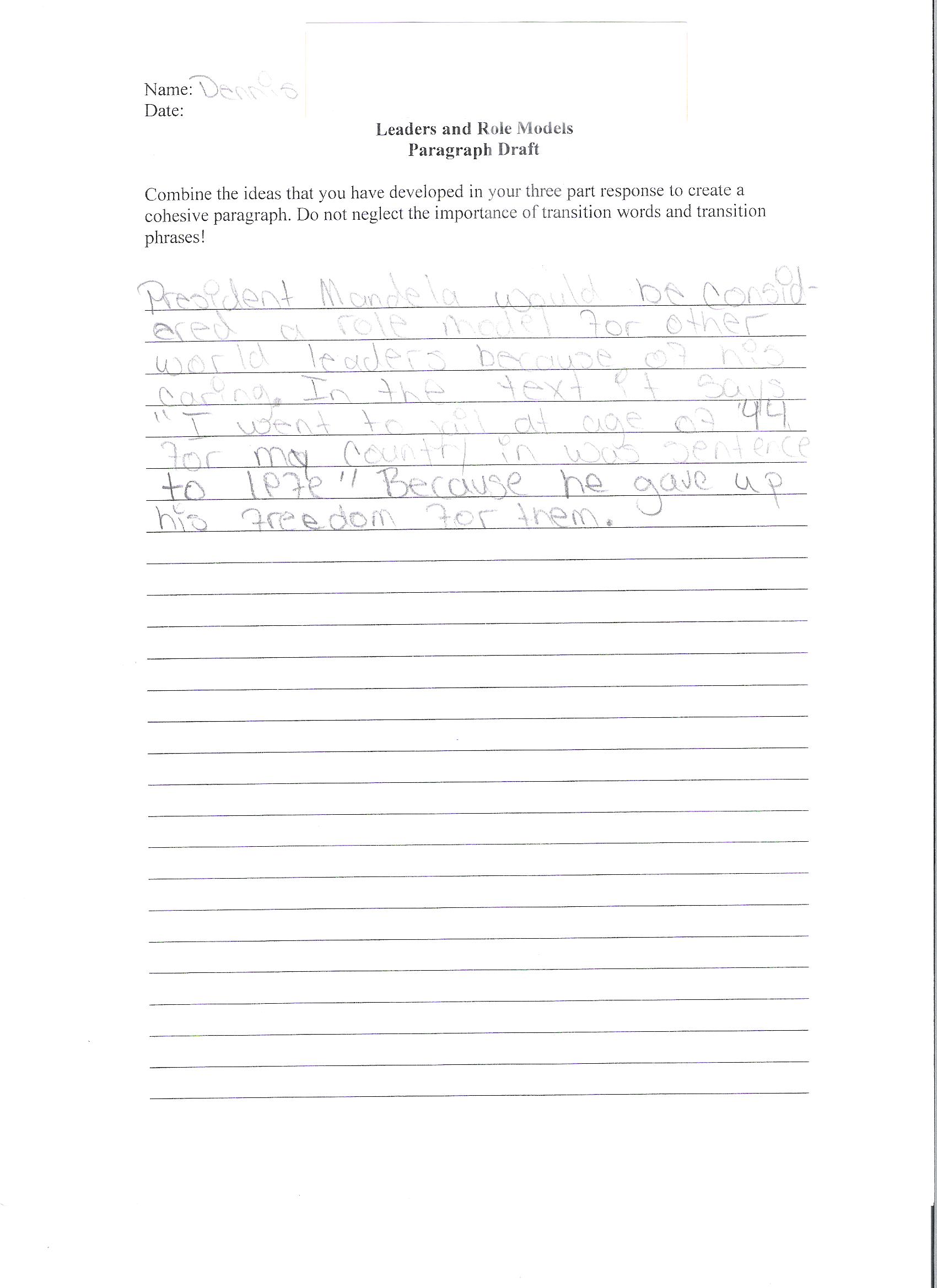
Student 2: Dennis Dennis’ writing and verbal communication skills are adequate, but he is frequently the kind of student who says “I don’t know how to put it into words.” Dennis and I work together at times to restate his ideas into a more logical or focused format. Dennis is currently reading about three levels below grade level; although he is not the lowest reader in the class, he is still below the class average. Although Dennis doesn’t quite always know what the question is he wants to ask, he is always willing to ask questions and participate during class discussion. This allows him the opportunity to try out his ideas and receive immediate feedback from his classmates or me. Dennis was able to successfully meet our first learning objective for the unit, however he is struggling to successfully meet the second objective. I have provided Dennis with clear questions and feedback, which I hoped would focus him on what questions he really needed to be answering. Based on the evaluation that Dennis gave in his outline, it is clear to me that he is still struggling with the concept. Dennis wrote, “This quote supports my [point] because he shows how much he cares for others.” During the time allotted in class for drafting, I had the chance to speak with Dennis and tried to encourage him to really get to the root of his meaning in that statement. In the time given, Dennis was not able to successfully compose a coherent paragraph, but his resulting work did indicate to me that he understands what he still needs to do.
Feedback to Guided Further Learning I wrote feedback directly onto the student drafts. Most of my feedback is in the form of questions or brief statements encouraging students to review what they have written or delve deeper into their ideas. Students received their drafts with feedback and will turn these drafts into a more finalized paragraph.
Kierra chose really good examples, but some of her understanding of the examples seemed slightly misguided. The way she worded one of her examples in both her outline and her rough draft made it sound as if she believed there were specific people employed by President Mandela who had personally tried to kill him in the past. The context of the statement that she was referring to was missing, and definitely changes its meaning. The context of the comment she was referring to was a general statement on the relationship of all blacks and all whites in South Africa before the end of Apartheid, not between specific people. On her outline, I made a comment to her, saying, “What did he mean by this? Did those specific people try to kill them?” These questions are aimed at having her question her own statement. After she read this, I discussed it with her because it is important that she both understands her misconception and writes a truthful response. For Dennis, I asked questions such as “How is this connected to your point?” and “How does this show that he cares for others?” My goal for Dennis is that he will have stronger support for his evidence and not just rely on the fact that I may understand the context of the examples. I want Dennis to develop a stronger use of written language to communicate his ideas. My questions are designed to develop his ability to express his ideas broadly and then narrow them down.
Using Assessment to Inform Instruction I initially chose to have the students write a Three Part Response because this was a writing format, which I had focused on a few times throughout the year that I feel the students have yet to master. I felt that reintroducing this format as a final assessment for the year would be a meaningful way to assess their growth as critical thinkers, communicators, and writers. After assessing the students’ outlines, I had a clear idea of what the students are still struggling with in this format. With this knowledge, I was better prepared for my “mini” introductory lesson on developing a paragraph the next day. Although I had developed lesson plans for this unit ahead of time, I was constantly adapting the lesson plan to fit what the students had struggled with the previous day or concepts that I felt needed further explaining. My next steps for instruction will be to take some of the stronger examples of evaluation and some of the weaker examples that the students have written and share them. I will have the students review and discuss each of these in pairs and then as a class to determine what makes one stronger than the other. My goal in this discussion is for students to identify the qualities of a strong evaluation and apply those to their own writing. For my focus students, I will check in individually with both (and attempt to check in with all students as well) as they go back to drafting. I will check how their evaluations have developed over the course of their drafts. As I collect drafts, I will continue to write comments and questions as needed to steer the students’ thinking and communication of ideas. I will take these particular next steps because the students have now reached the point in the writing process where they are performing independently and therefore need individual attention and support in different areas. I have provided each student with individual written commentary to guide his or her independent practice, now it is my chance to check in, one-on-one, and discuss how well that feedback was understood and applied.
Evidence of Academic Language Although Three Part Response is a writing format that we have used multiple times throughout the year, most of the students had forgotten the key academic language used in it (as evidenced by their responses to a Do Now). However, once the students were prompted with the word “point”, the terms “evidence” and “evaluation” came back to them quickly. Additionally, the students were able to fill in the outline template accurately, by putting the argument in the “point” section and the examples in the “evidence” section. This showed me that the students had a broad understanding of what each of these concepts meant, across the class. In a subsequent draft, in which students will include transitions, they will be asked to identify the three parts in a partner’s paper. This will show me that they understand the distinction between each part of the response. Open this link to view the rubric that I will use to asses the final draft of the paragraph.
|
||||||||||||||||||||||||||
Check out these files for Dennis' student work samples!
|
Check out these files for Kierra's student work samples!
|
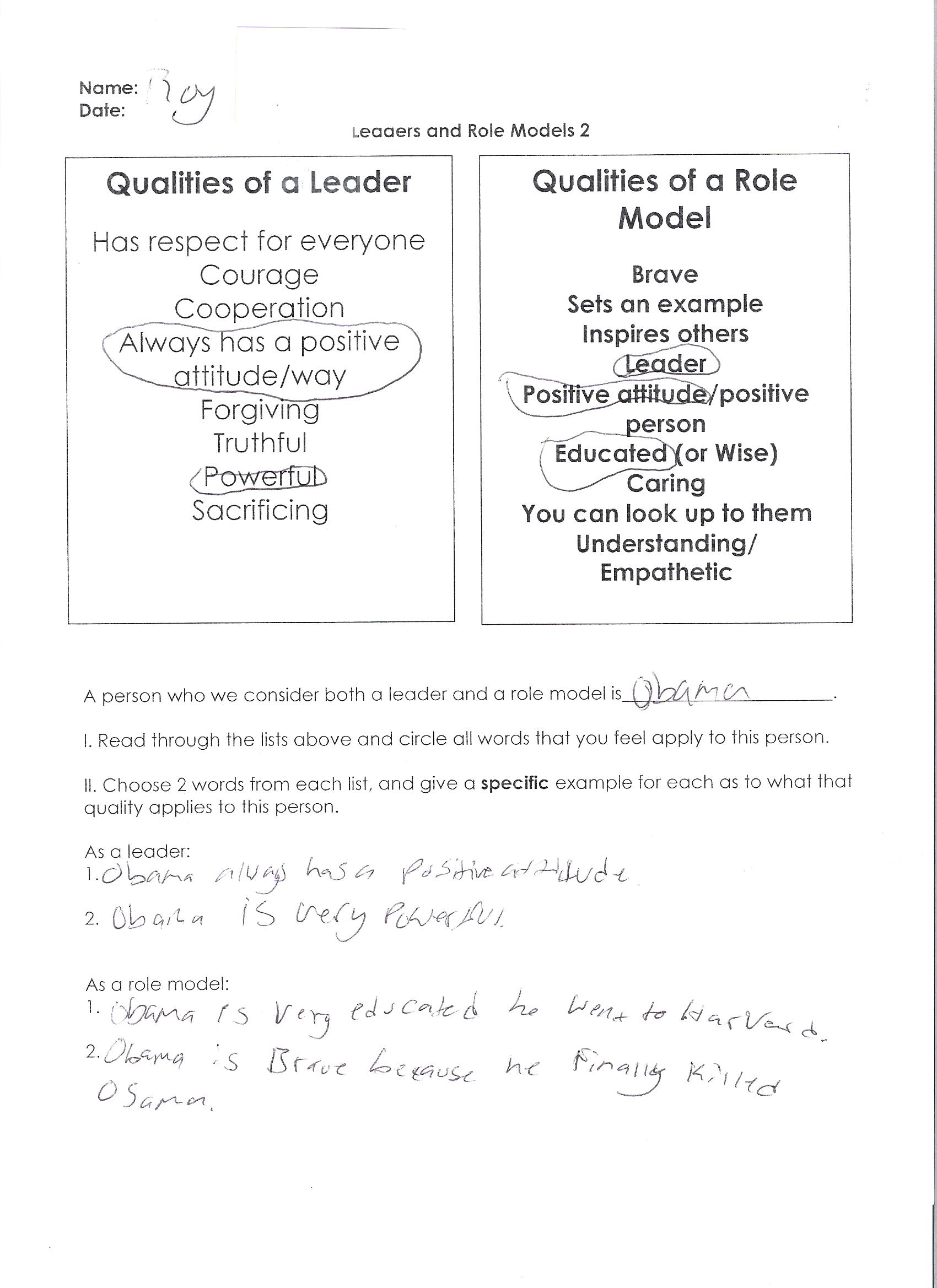
Check out these files for Roy's student work samples!
|
||||||||||||||||||||||||