Content Focus
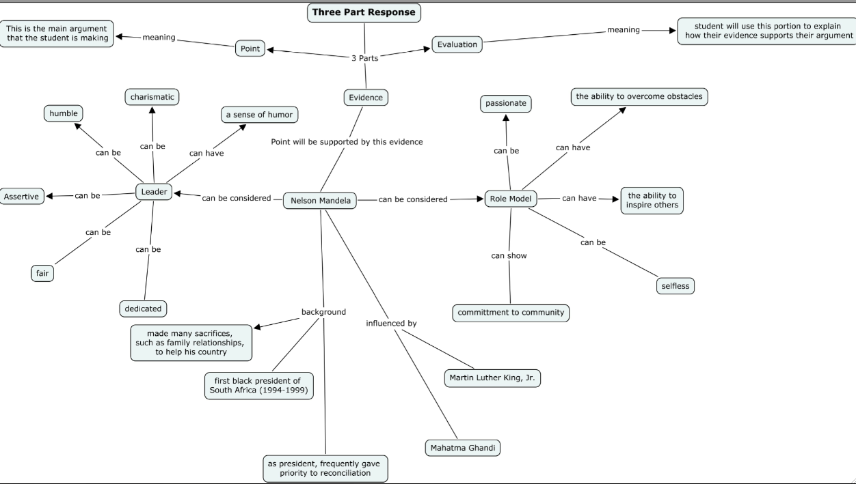
This learning segment happened within a larger unit on Nelson Mandela. In the unit, my students read excerpts from Long Walk to Freedom by Nelson Mandela, which were highlighted in their textbook, and viewed the film Invictus. As they read and watched, they answered guiding questions, which targeted their comprehension of the text and film as well as engaged them in higher order thinking and analysis about the issues presented in both. After reading the text, viewing the film, and discussing the portrayal of Mandela and his impact on South Africa in each, the students reflected on how Mandela’s actions showed that he could be considered a role model for other world leaders. The students developed definitions for the terms “leader” and “role model” based on their prior knowledge and personal examples. Finally, the students applied these definitions to their knowledge and understanding of President Mandela to create a well-supported paragraph that used textual evidence to support their reasoning.
In this unit, I asked the students at many different points to compare their understanding of the Civil Rights Movement in the United States in the 1950s and 1960s to their new understanding of the anti-Apartheid movement, and consider how the leaders of each movement impacted the outcome. This comparative and reflective focus was carried through to the lessons in which students were asked to create definitions for “leader” and “role model”. These definitions came up again and again in their writing, and it was very important that the students had a relevant, personal connection to them. The students were triggered to look into their own experiences and identify specific people who they considered to be leaders and role models. Once the students were able to make an emotional connection between an individual and the concept, they were able to create an academic definition using specific qualities of those individuals. After carefully considering and processing what qualifies these individuals as leaders and role models, the students were challenged to identify and defend those qualities in President Mandela. From this experience, I would like my students to be able to walk away knowing that they can apply the skills of identifying and analyzing in many different scenarios. In the long run, I hope that my students will use their understanding of leadership to apply it to their own behavior or how they evaluate individuals in their lives.
Knowledge of Students to Inform Teaching
Many of the students are reading just below grade level, according to their recent NWEA MAP test scores. Prior to being able to successfully complete this assignment, they will need the skills to write a cohesive and supported paragraph; this is a skill that we have worked on throughout the year. The writing assignment that the students will be completing as a summative assessment for the unit is a Three Part Response. A Three Part Response is the concept that I have been using to teach the beginning of expository writing. The paragraph is broken down into three separate components in response to a given prompt: the point, the evidence, and the evaluation. I have been working with them to scaffold their learning in how to develop a “point” (as I call it in the unit) or claim statement, choose examples from a text that support that claim, and then develop an explanation of the examples.
The students have been working on expository essays in their history class, so they have some understanding of how to use a text to support a thesis and an answer to a question. As of the last time the students completed a Three Part Response outline for my class, the majority of the students were capable of developing a claim statement as well as choosing at least one example from a text that supports that claim. However, a huge part of their struggle is developing an in-depth explanation as to why that example supports their point, and giving further evidence to support it.
One of the ways that I have scaffolded this kind of assignment for the students has been to provide sentence starters that create the frame for the academic language. Although some of the students have made enough progress in their writing to be able to develop their own unique sentences, many of the students still struggle to find the right wording to express their ideas without explicit modeling or sentence starters. The students also struggle with basic Standard English grammar and spelling conventions in their writing. This often impedes the readability and comprehension of the writing that the students do. However, the students are readily able to make comparisons and connections to their world when provided with specific and observable prompting. This is a key skill needed for success in the final lessons of the unit and the summative assessment.
This unit will be taught in a class of approximately twenty 9th grade students, ranging in age from 14 to15 years old. In this class, there is a huge range in the cognitive development of the students. This class has four students with IEPs and two others who are in the process of having an IEP written. Of those four students, two of them have the lowest reading scores in the class. One of them, based on a recent NWEA test, is reading at a 1st or 2nd grade level. The other students are all working between a 6th to 8th grade level. The student with the highest reading level in the class is reading at approximately a 9th grade level. This broad range in abilities means that there are constantly students working at different paces and comprehension levels, and there is great need for differentiation.
The majority of these students come from single parent or other non-traditional homes in low-income neighborhoods. For some of these students, there is limited parental involvement in their academics. I believe through the experiences at Collins Academy, especially with the involvement of City Year corps members as teaching assistants in the freshmen classes, the students would be able to identify at least one person who they consider to be a role model or a leader. For many of these students, their non-traditional family structure means that they find support in other ways; either from friends, religious groups, school professionals, or other individuals outside of their immediate family. Collins does a great deal to support students who have difficult home experiences through programs such as City Year Afterschool and the social worker’s office.
The class in which this unit was taught is a very active and vocal group of students. They are very willing to share answers with the class and participate in discussion. However, this particular group of students does not always show that they are the most mature second semester Freshmen, often acting out in ways that would be expected of much younger students. This group constantly struggles to work productively in partnerships or groups. During a group project assigned earlier in the year, there were multiple blowouts with group members (i.e. fights, refusal to work together). This greatly impeded the efficiency and productivity of the groups.
Description of Texts Used
For this unit, I chose multiple texts and video clips to help give the students a complete understanding of the topic. Prior to the learning segment that is highlighted in this portfolio, the students watched clips from a biography on Nelson Mandela and both the inaugurations of President Obama and Mandela. The students read some short biographical articles about Mandela to assist in creating a context for the students to understand his memoir within. The text that the students read and refered to throughout this lesson segment are excerpts from Long Walk to Freedom by Nelson Mandela. These excerpts have been chosen and put together by the textbook, Edge published by Hampton-Brown, that we have been using this year. There are three excerpts that the students read, which range in focus from talking about his inauguration as president to discussing the struggle and journey that Mandela had to take to get to there.
Finally, the students viewed the film Invictus. This film follows the story of the South African national rugby team in the months after Mandela’s election, and President Mandela’s effort to collaborate with the rugby team to begin to unite their country after the many years of division. The students used this film as evidence to support their points in their Three Part Responses, as well as the text.
Supporting Learning in English Language Arts
Upon first beginning to work with these students I noticed that they struggled greatly to make meaning from the texts that they were reading and give in-depth explanation for the meanings that they did find. For instance, they were readily able to identify what can be classified as “right there” questions, or questions that would have answers directly in the text without any additional analysis. However, when asked questions in which they needed to synthesize information that they found in the text with their own knowledge or beliefs, they struggled. As I have been working with the students, I have been pushing them to synthesize and apply their own ideas to the text. It is so important that these students have the ability and skills to go past basic comprehension because “being literate means not only to read and understand but also evaluate, critique, or interpret what we think of that text” (Swinehart,2009, p. 32). While reading the text and viewing the film, the students had been given sets of guiding questions that asked them both right-there and analysis questions, giving them practice at both of those skills. Finally, we discussed some of these guiding questions as a class.
I have sequenced this unit of lessons to give the students the most ownership over their understanding and development of their argument. I began the learning segment highlighted in this portfolio by having the students pull from their own experiences and background knowledge to develop definitions that they will use to apply to a character that we have been studying in the text and the film. Once the students have moved onto the writing portion, they will be initially using a format that they should be familiar with from previous lessons this year, in which we have used a very similar template. The goal of this is to make the students comfortable with the format that they are using so their writing will not be held back because they are adjusting to a new style or entirely new assignment. Essentially, the template is supposed to create the “bone structure” of their paragraph. This will give the students the opportunity to practice the application of their knowledge comfortably. Additionally, in all previous Three Part Response assignments the students have mostly worked with building the basic structure. I, now, asked them to build up their argument with additional supportive and transitional information.
There are a number of common errors that I have noticed the students make when working with this kind of writing. Especially when students are asked to give support for their explanations, students commonly write explanations that sound something like “because it said so in the book”. This superficial explanation shows that the student either has not been able to or does not have the language to analyze the text. To address this issue, I will be giving students sentence starters to get them past the obstacle of not having the language. We will also look at multiple good and multiple bad examples. Hopefully, the modeling and examples will give students an understanding of how they should be analyzing their own text and ideas.
In this and all units, all students will be given multiple supports that will aid them as well as any students with IEPs in developing their ideas. One thing that I have already designed in my classroom is intentional heterogeneous groupings. These groupings were assigned so that there are particular students seated near others to support their learning and act as peer tutors at times. This cooperative learning experience is very beneficial for all students in the classroom, not just those with learning differences. Haager and Klinger, in their book Differentiating Instruction in Inclusive Classrooms, mention that “[i]t is the differences among members- differences in their talents, skills, perceptions, and thoughts- that make a cooperative group powerful” (2005). Students will be working in mixed-ability groups to brainstorm their definitions for the key concepts that will be discussed throughout this unit, as well as to peer edit and develop their paragraphs.
The template that all students will be using has the potential to be modified for both students with learning differences and gifted students. Certain students, based on ability, may only need to choose one example from either the text or the movie to support their claim, rather than both. A gifted student may be encouraged not to rely on the sentence starters but to branch out on their own and develop completely unique sentences.
Supporting Student Understanding and Use of Academic Language
The key academic language that the students should be able to navigate is the language used to write their Three Part Response paragraphs. I expect that the students will know, understand, and use the terms “point”, “evidence”, “evaluation”, and “transition” when discussing the portions of their paragraphs. It is integral to the students’ development as writers that they can name and identify the different portions of their paragraphs because it will allow them to pinpoint the issues or strengths in their writing. A student who is able to say, “my transition sentences are not relevant to the rest of my paragraph” will have a much clearer idea of why his paragraph sounds disjointed than a student who says, “this part just sounds weird”. I want my students to not only be able to analyze and apply a text in their writing, but to become critical thinkers as they go through the writing process.
The template that the students used was given to them with each individual component already labeled with the proper terminology. As we moved into forming paragraphs, the students were asked to identify what each sentence of a sample paragraph would qualify as using the key terms. Finally, the students were asked to label each section of the paragraph, identifying each individual part in the editing and review process, to ensure that the structural integrity of their paragraph held together. As the supports are pulled away, it is very important that the language remains intact.
Monitoring Student Learning
The informal assessments throughout the process happened on a minute-by-minute, as well as day-to-day basis. Consistently throughout each day of lessons, we paused and discussed as a group whatever we were working on at that moment. These small discussions allowed me to check in with individual students as well as groups of students to see where their thought processes have lead them, and I addressed any confusions or misconceptions. Once students began writing, I collected their drafts at every step of the process. This allowed me to see how the class was doing as a whole, as well as address individual issues that may have come up. Constantly checking for understanding through verbal discussion and review of the writing allowed me to address problems as they arose, re-teach skills as necessary, and assess how well I was delivering the instruction of the new skills. Additionally, it allowed me to have a solid understanding of how the students are constructing meaning, and responding to the prompt and the text. Finally, the formal assessment for the unit will take place when the students turn in the final draft of their paragraph. This final draft will primarily show me how well they were able to construct their paragraph and synthesize the feedback that they received from their peers and me. The formal assessment will serve as their final writing assignment for the unit as well as the school year. It will take into consideration everything that the students have done along the way, not just their final product. This allows me to give students the credit that they have earned by putting in the cognitive work to develop this paragraph. Before I collect the final draft I will provide all students with the grading rubric that I will be using. I do not plan on modifying how the product will be assessed, rather what is produced.
Concept Map (made with CMaps) for planning
Lesson Plans for the Learning Segment
(with Reflections)
|
|

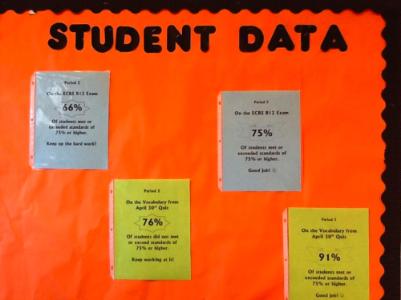
Below are images on the Marker Board Configuration and Data Wall displayed in my classroom. Both of these are used as reference points for myself and my students throughout the day and year.
 |  |
